



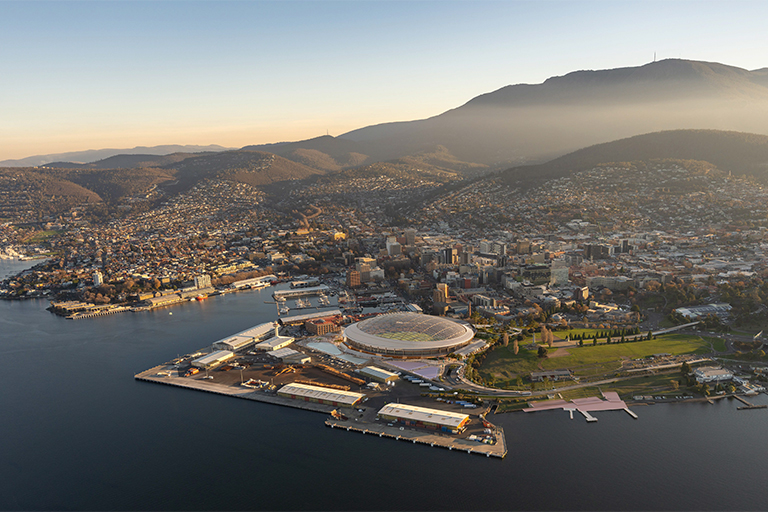
The Tasmanian Government has shortlisted Besix Watpac and a consortium known as Constructure Joint Venture, which includes Webuild S.p.A, China Construction Oceania and McConnell Dowell.
The Australian-founded Besix Watpac designed and built the just-opened One New Zealand Stadium in Christchurch in addition to working on projects including Suncorp Stadium, Queensland Country Bank Stadium and part of the Melbourne Park redevelopment.
Besix Watpac also undertook all of the construction for the decade-long transformation of The Gabba in Brisbane, which grew it from a 13,000-seat venue into the 42,000-seat stadium it is today.
In the consortium bid for the project, Webuild is an Italian company, which operates in Australia, with its local projects leaning more towards the industrial, including Snowy 2.0, the Suburban Rail Loop in Melbourne and the Sydney Metro Northwest.
Its consortium partner, China Construction Oceania, is a subsidiary of the state-owned Chinese construction company China State Construction Engineering Corporation, one of the largest construction companies in the world. Local projects include the Park Hyatt Auckland, which opened in 2020 and the North East Link road project for the Victorian Government.
The third consortium stakeholder is McConnell Dowell, a New Zealand company which also has a variety of industrial projects to its name.
“We have seen strong interest from major contractors capable of delivering a project of this scale and complexity,” said Tasmania’s minister for the renewal of Macquarie Point, Eric Abetz.
“This is another important step forward for the Macquarie Point multipurpose stadium.
“This project will create opportunities for Tasmanian businesses, subcontractors, workers apprentices and training opportunities as delivery progresses.
“We are delivering for Tasmania by turning a wasteland into a year-round events and function precinct that will provide benefits for all Tasmanians.”
The state government is looking to selected the builder by the end of the year.
Meanwhile the Victoria Park stadium in Brisbane, which is set to host the opening and closing ceremonies of the Brisbane Olympics in 2032, also has two shortlisted consortiums vying to take on the stadium build.
Besix Watpac is again in the mix, this time in collaboration with the multi-national John Holland, which has worked on the redevelopment of the Sydney Football Stadium in Moore Park and the Shane Warne Stand at the MCG.
The second consortium comprises Built and Sacyr. The Australian Built has worked on the likes of Nyaal Banyul Geelong Convention and Event Centre and Queen’s Wharf in Brisbane, while the Spanish multi-national Sacyr has sport, stadium and museum projects to its name, alongside historic refurbishments.
“GIICA has moved through an exhaustive Early Contractor Involvement process since we first went to market five months ago and we are satisfied that the two joint ventures selected are high-quality and vastly experienced construction teams,” said Simon Crooks, CEO of the Games Independent Infrastructure and Coordination Authority (GIICA).
“We look forward to working closely with both teams over the coming months as we drive forward with our design and planning program for a new Brisbane Stadium that all of Queensland will be proud of.”
GIICA’s executive general manager of delivery, Brendon Richards, noted the benefit of shortlisting the two building consortiums now.
“Engaging two highly experienced construction teams at this stage of the design phase means we can rigorously test buildability, sequencing, risk and opportunity early,” said Richards.
“This innovative process supports our commitment to delivering a world‑class Brisbane Stadium, whilst ensuring value for money and confidence in an on‑time, responsible and appropriate build Queenslanders are proud of.”
Construction on the 63,000-seat stadium, which will also have a 70,000-person concert capacity post-Olympics, is expected to begin in 2027.