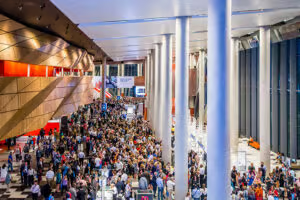



TMS APAC took place alongside the second edition of the Business Travel Show Asia Pacific and the inaugural, invitation-only Global Travel Marketplace Luxury Asia Pacific.
Held at Sands Expo & Convention Centre in Singapore on April 14–15, the almost-10 per cent attendance increase over 2025 showed confidence in the future of the business events industry.
The positive mood and outcome underscored the industry’s continued momentum in a challenging global landscape.
“The Meetings Show Asia Pacific has become a powerful barometer for where the global MICE industry is heading,” said Jason Young, CEO of the event’s organiser, Northstar Travel Group.
“The level of business activity, engagement and innovation seen here reflects the strength of Asia Pacific and its growing influence in shaping what comes next for our industry.”
Besides the usual country and corporate island-pavilions – many from global hotel chains – and standard booths, an open-plan, central zone caught attention.
It comprised four rows of 19 individual exhibitors representing diverse places, products and brands. Among them were destinations Budapest and Colombia, venue Western Sydney Convention Centre and hotel brands Capella, Dusit Thani, Marriott and Pullman.
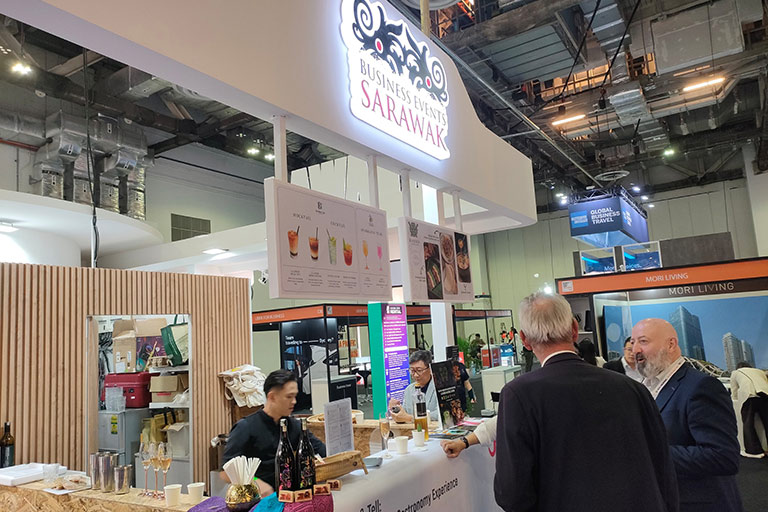
Returning exhibitor Business Events Sarawak (BESarawak), leading a dozen-strong delegation, flagged higher-quality leads, notably from Australia.
“Corporate buyers are prioritising lasting impact over mere attendance and tourism,” said BESarawak.
“Key interests include Sarawak’s location and highlights, the potential for larger events at Borneo Convention Centre Kuching 2 (2028 onwards) and corporate incentive trips to Mulu Caves.”
There was interest in Sarawak’s new, state-owned airline AirBorneo, heralding improved future connectivity and access to the destination.
Separately, BESarawak told micenet that 20 events in April and May were proceeding as planned with no cancellations, postponements or reduction in scale, amid the uncertainty generated by the Middle East conflict.
It is gathering feedback from organisers to identify if support or assistance is needed to deliver their events successfully as cancellation is impractical.
Illustrating the trend towards interaction and gamification at B2B exhibitions, TMS APAC organisers offered various sensory ‘bars’ to encourage attendee engagement through experiential discoveries and collectibles.
Event tech companies Searix and UPGroup Asia employed a 3D sphere lucky dip and virtual claw machine, respectively, at their booths, showing how fun can complement business discussions and demonstrations.
“We’re working closely with our clients to build events that are purposeful and adaptable, designing programs that deliver strong stakeholder value while remaining responsive to evolving timelines and budgets,” said Adam Piperdy, founder and chief experience officer for UPGroup Asia.
Organisations are taking a more strategic approach to their events, prioritising measurable outcomes, ROI and flexibility in planning. This has led to more focused, higher-impact experiences.
Southeast Asia continues to present strong opportunities for Australian organisations, he added.
“Singapore, in particular, remains one of the region’s most active business event destinations. Our venue partnerships across Singapore, Thailand, Malaysia, Indonesia and Vietnam and end-to-end capabilities make it straightforward for Australian clients to bring their events here, with confidence in the outcome and control over the cost,” Piperdy said.
South Korea made a strong debut with a team of 22 representing provincial and city tourism and convention organisations, venues, hotels, attractions and DMCs. Meanwhile, Tourism Indonesia’s seven-member delegation had a strong community and experiential events focus.
Some buyers commented on the minimal presence from Hong Kong and Thailand; a few hotels were scattered among corporate stands or at the central pavilion.
Among PCOs, Gina Samuels, director of The Production House Events, Australia, noted more cautious planning across Australia and New Zealand with shorter lead times, flexible contracts and a stronger push into Asia, particularly Singapore, for stability and access.
“Sectors like medical and tech remain resilient. Intermediaries and suppliers are collaborating earlier with clients to manage risk while maintaining momentum and delivering scaled but still high-impact events,” she said.