



Topics went beyond the usual to include tips on navigating current challenges.
“The education program was carefully curated to address the most pressing conversations shaping business events today, from AI adoption and ROI accountability to talent and workforce challenges,” said Robert Sullivan, chief commercial officer and president of Northstar Travel Group.
“What stood out was the strong engagement across these themes, as well as the response to sharper, more actionable formats such as Talks in Ten, which delivered timely and practical takeaways.”
Here are key points from some sessions micenet attended.
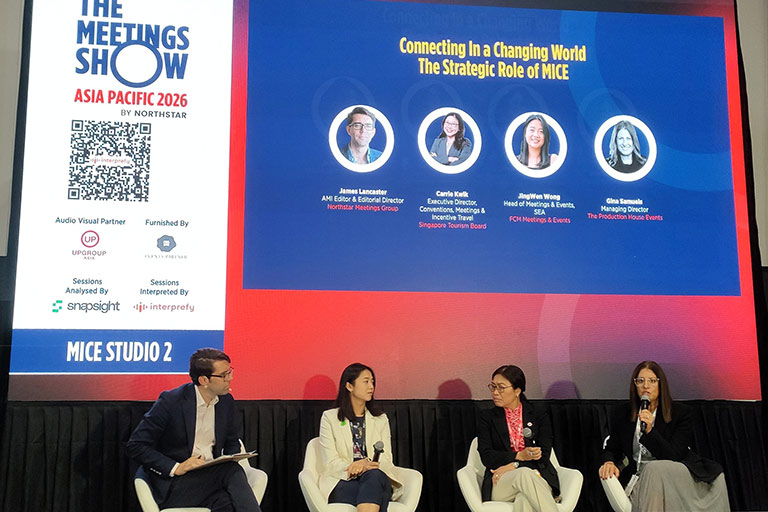
On the strategic role of MICE in a changing world, panellists from FCM Meetings & Events, The Production House Events (TPHE) and Singapore Tourism Board stressed that global connection is still important despite geopolitical uncertainty. Flexibility and adaptability are essential, as is empathy from suppliers.
FCM shared how an in-person event became hybrid within 24 hours when many speakers and attendees could not travel due to geopolitical tensions.
TPHE said Australian planners may face logistical hurdles, hence the need for creativity and adaptability to overcome them.
The consensus was that Singapore’s strengths – connectivity, stability and strong infrastructure – make it a preferred hub.
The panel identified growth markets like Vietnam and sectors such as tech, biotech and medical as offering new opportunities. Sustainability, CSR and culturally tailored experiences are gaining traction. However, some things “could be done better”, such as reducing food wastage at events.
Snippets of the March Cvent Pulse Survey, undertaken in collaboration with Northstar Meetings Group, showed declining planner optimism globally, especially in North America. Chief concerns were geopolitical tensions, visa issues and rising costs.
Despite the softer outlook, sourcing activity holds firm. Faced with flat budgets, planners are seeking more cost-effective destinations and venues.
According to the survey, Singapore was the top Asian destination for 75 per cent of respondents, followed by Thailand, Malaysia and Vietnam (60, 50 and 49 per cent, respectively).
A panellist from REALM Events observed the event process is starting earlier, with clients expecting more while budgets stay the same, and some even going direct to suppliers.
Sustainability has become an expected standard in APAC and Europe, Middle East and Africa (64 per cent) compared with North America where only 34 per cent of organisers or clients have a policy for their events. The challenge in APAC is that clients want sustainable practices without added costs.
American Express Global Business Travel discussed current issues caused by the ongoing Middle East war in its presentation on 2026 global meetings and events trends, in addition to highlights from the American Express Meetings Forecast done in mid-2025.
Key concerns now are increasing airline and venue costs, including F&B, safety and crisis preparedness, including delegate tracking and contingency planning.
Amex said meeting and travel policies, spending and locations must be reviewed, and better use made of AI in event planning, content creation, impact and retention through timely follow-up.
The ROI – ROE topic emphasised aligning event objectives with measurable business outcomes. Corporate examples revealed internal AI platforms and audience profiling – it’s not about numbers but how many of the “right people” attended.
Searix and UPGroup Asia introduced the “Attention, Engagement, and Action Framework” to design impactful events – well-suited to Millennials and Gen Z, who now form 42 per cent of conference attendees and want interactive, memorable experiences aligned with their preferences.
They showed examples of events featuring experiential activities instead of static displays to boost brand affinity through meaningful engagement.