


“I started in the industry when I was 15,” says the co-founder of South Australian hospitality and catering company, Blanco Horner. Working in restaurants, functions and a nightclub, Horner was exposed early to the energy, discipline and rewards of hospitality. By 18, he was running a nightclub.
More than four decades later, hospitality remains the only industry he has ever wanted to know.
“This is all I know how to do, 40 years on,” he says. “And I love it. I love it daily.”
Horner’s early career coincided with a formative period for South Australian dining. Restaurant culture was expanding, the state’s festival identity was flourishing and institutions such as Regency TAFE were helping transform hospitality from a job into a recognised profession.
“I was probably on that cusp of, yes, it is a job, but then starting to make a career out of it,” he says.
He moved into hotel food and beverage management before working with prominent South Australian restaurateur and hotelier Bill Sparr, whom he describes as an important mentor. The experience exposed him to international chefs, ambitious restaurant concepts and large-scale operations.
Today, that appetite for progress remains central to Blanco Horner.
“The ability to look at continuous improvement is our motivator,” Horner says. “It’s what keeps me inspired.”
For him, improvement is not confined to menus or presentation. It includes developing chefs, building front-of-house careers, refining systems and creating a company in which employees can grow.
“We’ve made careers for these people,” he says. “People have changed their lives and their careers with us. If these people have got to grow, we’ve got to grow.”
The company’s work now stretches across restaurants, corporate functions, major events, contract catering and highly specialised operations, including airline meals for both Virgin and United Airlines’ Adelaide to San Francisico route.
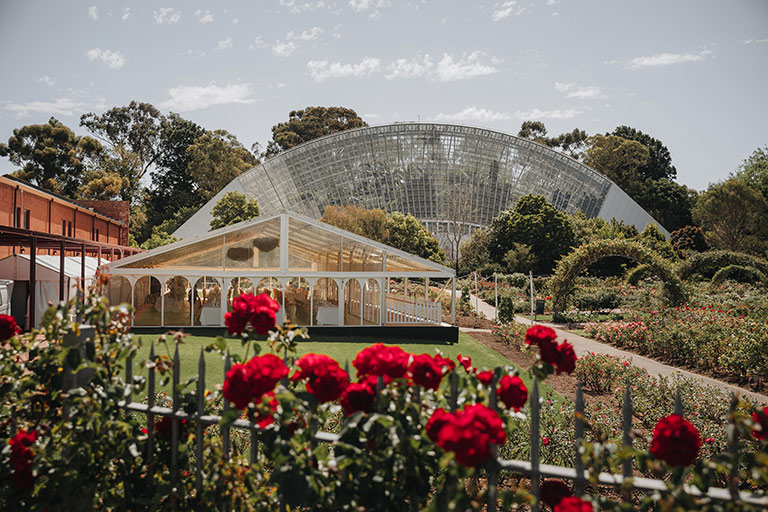
Planners who have delivered events in Adelaide may know Blanco Horner’s Restaurant Botanic, their fine dining establishment set within Adelaide Botanic Garden on the edge of Adelaide’s CBD, not far from the convention centre.
So while planners are consistently looking for something bespoke and polished, but without the expensive pricetag, Horner says it’s finding that balance of delivering polished dining experiences in locations far removed from a traditional commercial kitchen.
That might mean a black-tie but barefoot beach BBQ for a client like Penfolds.
“Sometimes they just want uniqueness,” he says.
Yet he cautions that the spectacle surrounding an event cannot be separated from the food. In fact, he calls on planners to consider the catering as one of the most important time-sensitive aspects of an event.
“The kitchen works to an exact timeline, even when the entertainment program does not.”
An entertainer might be allowed to perform a second encore because the audience is enjoying the moment. But backstage, steaks may already be resting, sauces may be reducing and plates may be ready to leave the pass.
“Suddenly, the food is overcooked,” Horner explains
It’s a vivid example of how what might be considered the “fluff” of an event can directly affect the dining experience. A few extra minutes in the program can ripple through the kitchen and undermine hours of planning.
Horner argues that successful events depend on close communication between planners, producers, entertainers, chefs and service teams. Flexibility is important, but so is understanding that food has limits.
“You’ve got to be at the top of your game,” he says. “When you drop the ball, that’s when you might lose a contract.
“We say to clients, ‘challenge us’…We aren’t too proud to work with a client’s own chef or a celebrity chef…or take on a brand for the event.”
Horner is also watching the industry’s growing focus on provenance and sustainability. Clients increasingly want local, seasonal produce, but often combine that expectation with requests for premium ingredients transported from interstate.
“There’s this provenance of food and sustainability, but then the client goes, ‘Yes, but I want a luxe element,’” he says, adding that the challenge is balancing those competing demands while remaining honest about seasonality, food miles and what is genuinely available. Luckily, he says, South Australian produce is renowned for its quality.
Likewise, he says, while the focus on Indigenous ingredients might be trendy elsewhere, to Blanco Horner, it’s just part of the dining experience.
Horner explains that chef Jaime Musgrave at the helm of Restaurant Botanic has spent time out on Country, tasting foraged ingredients and giving him a deep understanding and respect for native foods.
Musgrave doesn’t believe these ingredients are a trend, they’re simply what Australia tastes like.
After more than 40 years, Horner says his philosophy remains grounded in improvement, people and precision. In hospitality, excellence is rarely one dramatic gesture. It is the cumulative effect of hundreds of decisions, all arriving at the right moment.
Preferably before the entertainer launches into one more encore.