



In its annual results release, out today, the airline group reported strong demand for both domestic and international travel but flagged a $420 million hit to earnings as a result of the conflict in the Middle East.
Qantas also noted that domestic travel demand from government and large corporates was affected by the conflict and “other economic headwinds” but says it retained its market share. Alongside this, the airline says it saw a jump in demand for travel to Europe due to the conflict as passengers moved away from Middle Eastern carriers and that revenue growth in premium cabins for international long haul routes was double that of economy.
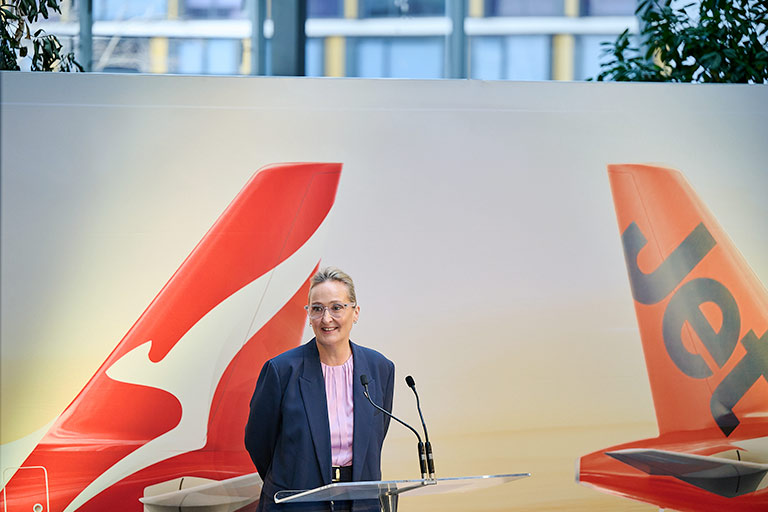
“This year was defined by two very different operating environments, as a result of the conflict in the Middle East,” said Qantas group CEO, Vanessa Hudson.
“In the first half, Qantas and Jetstar were both performing strongly, with demand growing across the domestic and international networks.
“Our new aircraft allowed us to add capacity and open new routes, which helped us to increase revenue.
“Qantas continued to see growth at the premium end of the market while Jetstar went from strength to strength and continued to deliver value, when many are feeling cost of living pressures. This performance highlights the benefits of our dual brand strategy.
“The final four months of the year saw business and consumer confidence fall as the conflict and economic headwinds created uncertainty, and some large corporates and government responded by managing their costs more tightly, reducing demand for travel.
“In response to the surge in fuel prices, we quickly adjusted fares and capacity, and redeployed aircraft to give customers more options to fly to Europe.
“These actions, along with other mitigations, limited the net impact on earnings to $420 million, despite a $610 million increase in our fuel bill,” said Hudson.
Qantas has also announced that it will phase out its A380 fleet, starting in 2028, as it welcomes more new-generation aircraft into service.
“Our fleet renewal continued at pace, with 17 new aircraft arriving during the year and up to 31 more to arrive in the year ahead, with the majority joining Qantas,” said Hudson.
“Customers are telling us how much these aircraft are improving the flying experience, and they’re a big part of what’s driving our financial performance too.
“With our first Project Sunrise A350-1000ULR to arrive in April, and more A350s and 787s on the way, it’s a new era for Qantas’ international fleet with these next generation aircraft set to transform the way our customers travel. This means we can commence the retirement of our A380 fleet from 2028.”
The airline is also in talks with aircraft manufacturers Airbus and Boeing to order more aircraft from 2030.
“Transformation continues to be a priority, helping offset rising costs so we can keep investing in our business for the future,” said Hudson.
“With cost pressures set to continue, transformation will help us manage these increases and keep delivering for our customers and our people, including through the increased use of technology and AI.
“This has been another year of progress, with customer satisfaction at its highest in a decade and world-leading operational performance, even as the aviation industry faced record high fuel costs and disruption from the conflict in the Middle East,” said Hudson.
Looking ahead, the airline is expecting fuel prices to remain high for the first half of the current financial year. Its capacity guidance for the year ahead shows domestic capacity falling across the whole of the current financial year, more so on Qantas services, than Jetstar.
Paradoxically, international capacity is set to rise in each quarter, favouring Qantas rather than Jetstar.