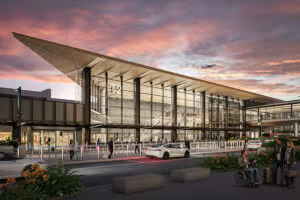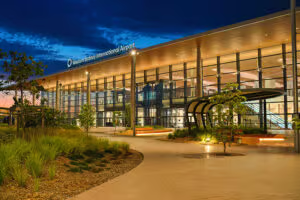



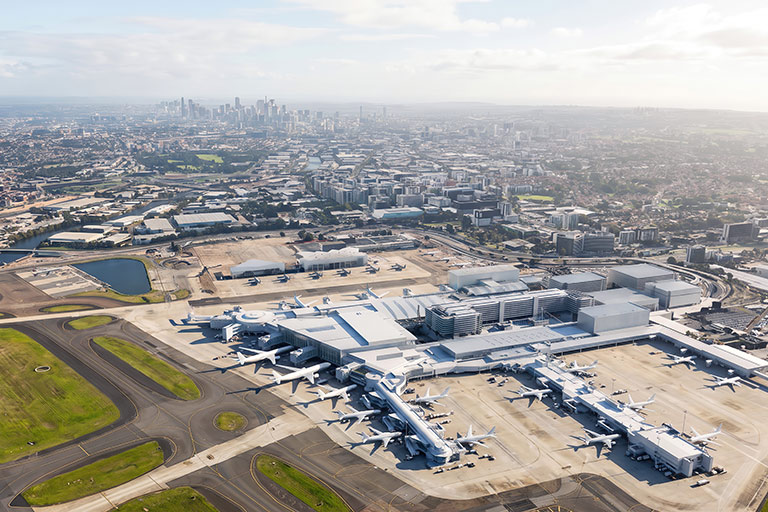
The plan includes expansion of terminals 1, 2 and 3 and the integration of terminals 2 and 3, with both domestic and international flights to fly out of the newly combined terminal. The integration has the potential to add up to 12 new international gates in the T2 and T3 precinct. Alongside this, the master plan proposes two more gates for the T1 terminal.
The plan also includes opportunities to add new hotels to the airport’s footprint, including between 200 and 500 rooms near T1 and 500 to 900 rooms near T2 and T3.
The master plan forecasts that by 2045, Sydney Airport will service 72.6 million passengers annually, compared to 42.54 million total passengers through the airport in the 2025 calendar year. These 72.6 million passengers will fly on an anticipated 385,000 services arriving and departing from the airport. As a result, the airport expects to play a role in generating $70.6 billion of economic activity by 2045.
“Kingsford Smith is Australia’s busiest airport, it must remain fit for the future,” said federal transport and infrastructure minister, Catherine King, in a statement confirming approval of Sydney Airport’s master plan.
“Airports aren’t artworks, they’re constantly evolving to become more efficient and improve the passenger experience and this new master plan maps out the airport’s plan to do just that.
“As demand grows, a modern Kingsford Smith will remain crucial to transport, tourism and industry across NSW and the nation.”
Sydney Airport’s CEO, Scott Charlton said, “as Sydney grows, Sydney Airport must grow with it”.
“Approval of Sydney Airport Master Plan 2045 provides a clear pathway to plan for future demand and invest in the infrastructure Sydney will need over the next two decades,” said Charlton.
“As Australia’s international gateway, this plan ensures we can continue supporting tourism, trade, investment and jobs while delivering the capacity needed for future generations.
“Importantly, it provides a framework for growing sustainably and responsibly, minimising environmental impacts and working closely with the communities surrounding the airport.”