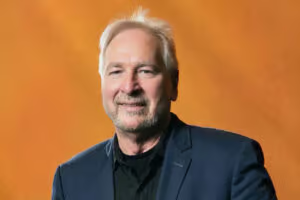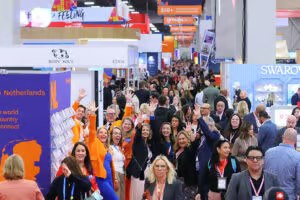


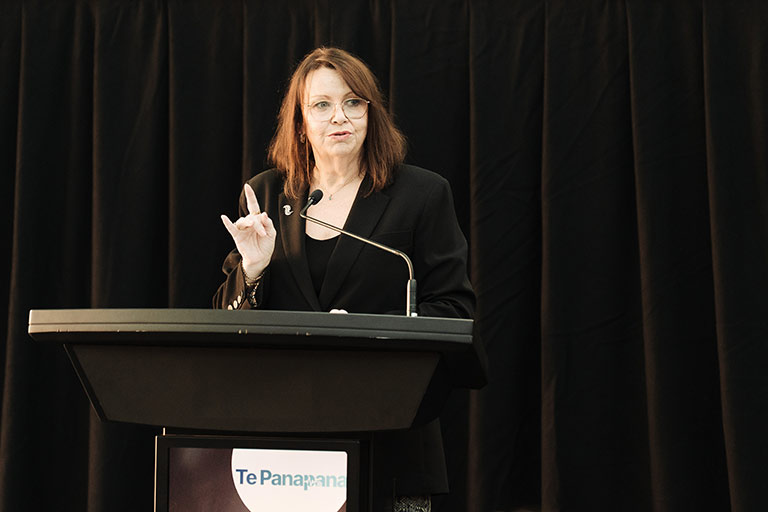
Chief executive of Business Events Industry Aotearoa (BEIA), Lisa Hopkins, spoke to industry leaders and media on Tuesday, ahead of the opening of the MEETINGS show floor, which saw hundreds of buyers meet with sellers to discuss future business events in New Zealand on Wednesday and Thursday.
Hopkins opened her speech by addressing recent comments made by US Secretary of Defence, Pete Hegseth, at the Shangri-La Dialogue in Singapore, in which he suggested more combat power was needed rather than more conferences.
“I understand the context in which those comments were made,” said Hopkins.
“Governments have a responsibility to protect their people and security matters.
“But history tells us that progress is rarely achieved through military capability alone. The world’s greatest advances have come when people gather, exchange ideas, challenge assumptions, build relationships and find common ground.
“Because before there is cooperation, there is conversation.
“Before there are trade agreements, scientific breakthroughs, policy solutions or diplomatic agreements, there are people in rooms together, sharing knowledge and building understanding.
“And that is precisely why business events matter.
“The Shangri-La Dialogue itself exists because dialogue is preferable to conflict. Its value lies not in the ships or submarines that may be discussed, but in the conversations that help nations understand one another and, hopefully, avoid the need to use them.
“The world has benefited enormously from the conversations that take place at conferences. They may not always make headlines, but they help build trust, solve problems and create the conditions for peace, progress and prosperity,” said Hopkins.
“The world needs both security and dialogue. But if we can solve a problem around a conference table before it reaches a battlefield, that will always be the better outcome.”
She went on to suggest that business events were being looked at “through the wrong lens” in New Zealand.
“What if the real value of business events has never been the event itself?” she asked.
“What if the true value lies in what happens because the event took place?
“That is the conversation I believe New Zealand needs to have as we enter election year 2026.
“The business angle of business events is often underrated and disconnected from what this sector does, and this year, BEIA will be working hard to elevate the thinking of the policy makers, the business leaders and indeed, our own sector.
“Every year, business events bring decision-makers, researchers, investors, entrepreneurs, academics, business leaders and industry leaders into New Zealand.
“People who make decisions. People who invest. People who influence policy. People who shape industries. People who create jobs. People who solve problems.
“And when those people come together, interesting things happen.
“Ideas are exchanged. Partnerships are formed. Research is shared. Businesses grow. Investment opportunities emerge. Knowledge moves. Influence grows.
“Yet these outcomes rarely appear in the statistics we use to describe our industry,” said Hopkins.
“The time is right for us to stop talking about just money and start talking about why this industry should be recognised as a strategic economic and intellectual asset for New Zealand.
“Because the conference that leads to a medical research breakthrough fills hotel rooms, but how do you put a value on the lives it will save?
“The event that helps attract investment into a New Zealand technology company spent nights in local restaurants, but how do you measure the impact that investment will generate?
“Those are the outcomes we need to start talking about.
“Around the world, countries such as Australia, Singapore, Ireland and Canada are increasingly using business events as tools for economic development.
“They deliberately attract business events that align with sectors they want to grow.
“Strengthen industries. Attracting talent. Encouraging investment. Showcasing expertise. Supporting innovation.
“And perhaps most importantly, they understand that business events create connections. And connections create opportunity.”
Hopkins said New Zealand was already able to host great business events but questioned “whether we are deliberately using those events to support the future economy we want to build”.
“New Zealand is having conversations about productivity. About exports. About innovation. About investment. About capability. About economic growth.
“This is the only sector which cuts across all those issues. Not because we have the answer to every challenge. But because we are one of the tools available to help address them.”
Hopkins said, ahead of the election, BEIA will talk to government about how it should support business events and how it could use business events more strategically to progress national priorities and economic growth.
She said her association had identified four pillars ahead of the election – using business events to support clusters of excellence, grow foreign exchange earnings and attract high-value visitors and build capabilities across various industries, as well as positioning business events as national economic infrastructure.
“Success in this means we leverage business events to connect New Zealand to the world, accelerate knowledge, innovation and capability in the industry and we grow, as a country, our international influence.
“In 2026, BEIA will be asking politicians to recognise this sector, hear from this sector and encourage officials and ministries to leverage it.
“Specifically, we will be asking the government, both central and local, to elevate investment. What we believe is missing is a more deliberate and coordinated national approach.
“We will be identifying opportunities to make it easier for New Zealand to be the obvious choice as a business events destination, with access to investment and specific policies which will drive this.
“Business events sit at the intersection of multiple portfolios, including tourism, economic development, trade, education, science and innovation. As a result, responsibility often sits across several agencies and levels of government,” said Hopkins.
“A more coordinated approach would mean better alignment between national priorities, event attraction activity and long-term outcomes.
“This includes stronger collaboration among the central government, local government, economic development agencies, conference bureaux and industry.”
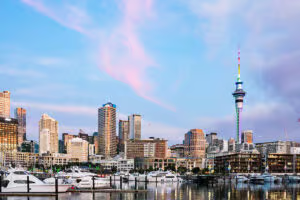
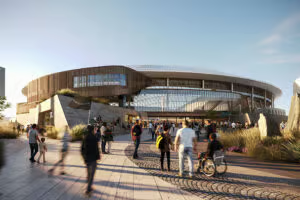
Hopkins’ speech comes just after the opening of the New Zealand International Convention Centre (NZICC), the last in a trio of new convention centres in New Zealand, which allow the country to host international meetings at a new scale across Auckland, Wellington and Christchurch.