

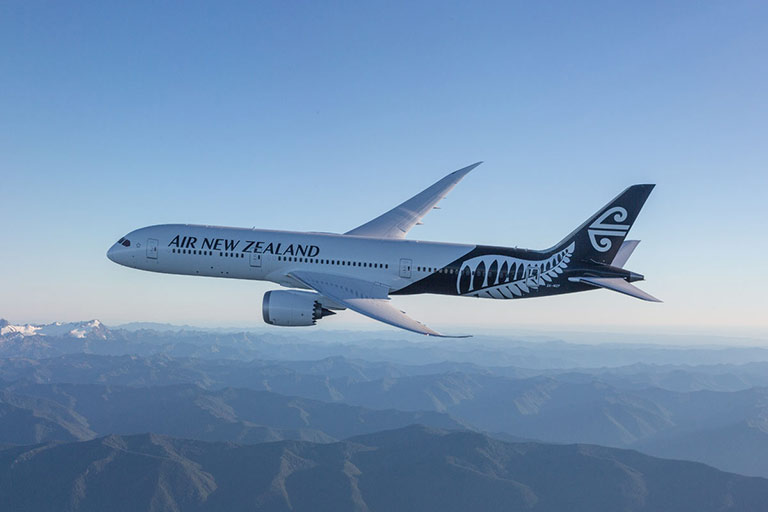
Air New Zealand flagged major increases to jet fuel prices due to the Middle East conflict alongside ongoing engine availability issues, aviation system costs and maintenance costs as the reasons the carrier made a before tax-loss of NZ$336 million (A$278 million), translating to an after-tax net loss of NZ$242 million (A$200 million).
Revenue for the airline was up by 3.9 per cent over the year, compared to the previous year, however raised fuel prices had a NZ$135 million (A$112 million) impact on the before-tax result, while engine availability dragged the result down by another NZ$190 million (A$157 million).
Air New Zealand also noted that aviation system costs were up by a further NZ$83 million (A$69 million) in the 2026 financial year compared to the year prior, with these costs rising at double the rate of inflation since 2019, and that the airline had a maintenance bill that was NZ$139 million (A$115 million) higher in this last financial year.
Air New Zealand CEO, Nikhil Ravishankar, said it had been a challenging year for aviation.
“Our financial result reflects these challenges,” he said.
“Given the price sensitivity of air travel, airlines globally have not been able to recover the full increase in fuel costs.
“We took quick and decisive action through fare adjustments and capacity reductions to balance affordability for customers and maximise recovery and will continue to do so.
“However, we are making real progress on what we can control, including improving our on-time performance from 77.5 per cent in 2025 to 84.0 per cent in the second half of the financial year, alongside an improvement in customer satisfaction.
“These are very significant improvements and have been the result of a detailed operational and resilience-driven review of our schedule that included a focused programme of initiatives across our team, and the rollout of new digital tooling in support of operational communication and decision making. We continue to invest in this area with a goal of being one of the top five airlines in the world for reliable and punctual operations.
“We have also taken decisive action to simplify parts of the organisation and evolve our operating model, including restructuring across a number of areas to reduce duplication, sharpen accountability and improve productivity.”
Ravishankar also flagged other positive developments for the airline.
“We have retrofitted nine out of 14 of our Boeing 787 fleet – and the new interior product is resonating very well with customers. The remaining 787 fleet fit-out will be completed by November this year, slightly ahead of schedule.
“Additionally, after several years of disruption, the engine challenges that have constrained our network are now substantially behind us.
“Our teams have worked relentlessly with Rolls-Royce and Pratt & Whitney to return grounded aircraft to service earlier than expected, with aircraft availability improving by the end of the financial year. There are still residual risks and costs to work through, but we enter 2027 in a considerably more reliable fleet position.
“This progress matters, but there is still work to be done,” he said.
“We are making deliberate choices on capacity and taking a disciplined approach to both our costs and our capital. Our focus now is on translating the operational momentum we have built into stronger and more sustainable financial performance.”
Meanwhile, the chair of Air New Zealand’s board, Dame Therese Walsh, said the board and the airline’s management team have “a well-defined plan to rebuild a financially resilient and commercially sustainable national airline” via the carrier’s new strategy.
“As the national airline, our success is closely connected to New Zealand’s success,” said Walsh.
“By strengthening our business and positioning Air New Zealand for sustainable growth, our strategy reset will enable us to play an even greater role in supporting tourism, exports and New Zealand’s long-term economic prosperity.”
The airline noted that without the impact of the raised fuel costs as a result of the Middle East conflict – which it expects to remain an issue in the current financial year – Air New Zealand was anticipated to return to profit this year. However, now the expectation is the year will be one of “transition and recovery”.
“We are seeing encouraging inbound demand, with strong forward bookings into New Zealand,” said Ravishankar.
“This is a positive signal for tourism and for the country more broadly. New Zealand remains a highly desirable destination, and our investment in our onboard product and unique Kiwi hospitality puts Air New Zealand in a strong position to bring more international visitors to our shores.
“We remain focused on executing our strategic priorities, improving financial performance and positioning the airline for long-term sustainable returns.”