
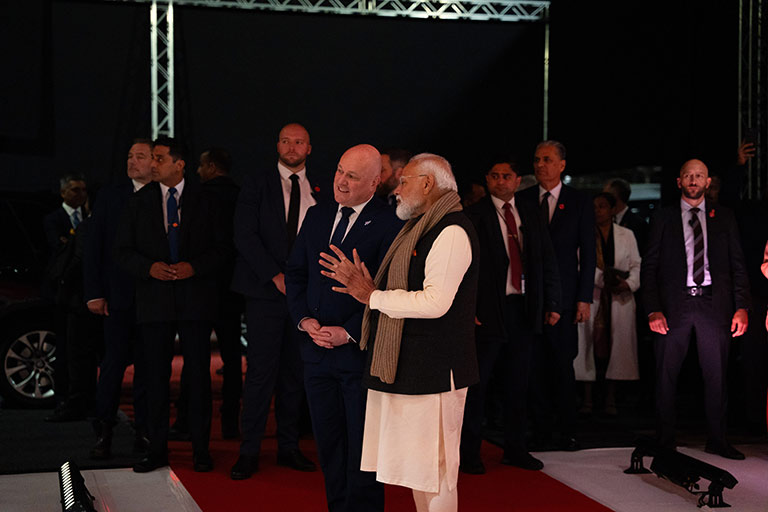
His high-profile visit followed the signing of the New Zealand-India free trade agreement (FTA), which is expected to boost business events from the growing Indian market and showcase New Zealand’s strength as a host destination.
Prime Minister Modi stayed overnight at Cordis, Auckland and attended meetings and celebrations at the Viaduct Events Centre and Spark Arena.
Prime Ministers Christopher Luxon and Modi signalled their two countries’ ambition to do more together by elevating their relationship to a strategic partnership and agreed a roadmap to 2030.
On Saturday, Luxon welcomed Modi to the India-New Zealand “A Winning Partnership” celebration, which focused on sporting connections and collaboration between the two countries, at the Viaduct Events Centre on the Auckland waterfront.
Modi’s visit ended with a large-scale community event at Auckland’s Spark Arena, attended by more than 10,000 Kiwi Indians, who comprise around six per cent of the population.
Air New Zealand and Air India signed a Memorandum of Understanding (MoU) in 2025, with the intention of establishing direct flights between the two countries, which would deliver a significant boost for hosting Indian incentives in New Zealand as well as increasing Indian delegates at international conferences held in New Zealand.
Business Events Industry Aotearoa (BEIA) chief executive, Lisa Hopkins, said the New Zealand-India free trade agreement is significant for the business events sector.
“India is one of the world’s fastest-growing outbound markets, and we are already seeing that reflected in New Zealand,” said Hopkins.
“Conference and incentive arrivals from India are tracking 137 per cent higher for January to April this year than for the same period last year.
“The FTA builds on that momentum by creating opportunities for deeper engagement between the two countries.
“Beyond reducing barriers to trade, the agreement recognises the importance of business cooperation, professional mobility and exhibitions. Business events provide the platform where these come to life.
“We see the FTA driving greater demand for conferences, incentives, exhibitions and business missions that bring people together to develop those relationships.
“For our sector, it creates an opportunity to strengthen our position as a place where conversation, investment and collaboration begin, but also as an aspirational destination to experience,” she said.