



The research flagged some significant – and at times surprising – shifts and issues for the incentive travel sector.
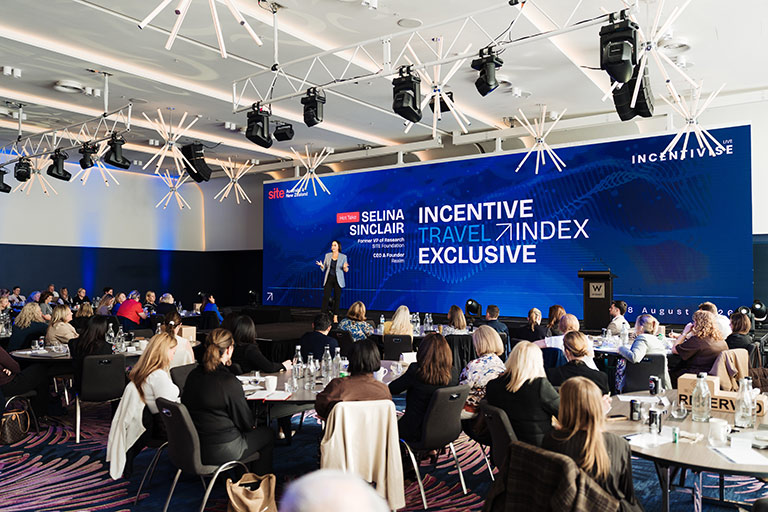
Results from the latest annual Incentive Travel Index, a collaboration between the Society for Incentive Travel Excellence (SITE) and the Incentive Research Foundation, were presented across two sessions at Incentivise Live, which was organised by the Australia and New Zealand SITE chapter.
“The industry is resilient. This is an important point just to frame the entire conversation that we’re going to have,” said Padraic Gilligan, co-founder of SoolNua and former chief marketing officer for SITE, who joined the Sydney conference remotely, presenting from Ireland.
“We’ve lived through some fairly seismic global occurrences that have had a massive impact on what we do. And I think in all cases what can be said is we’ve ended up being an extraordinarily resilient industry in response to those changes,” he said.
Much of the research suggests the industry will need to draw on its resilience now.
“We have been very much in an era of optimism over the last number of years,” said Gilligan.
“We’ve had year-on-year growth. But we’re not seeing that now, frankly.
“The expectation that activity across the incentive travel spectrum is going to increase in [the] next year is not the case. For buyers, it’s a drop from 33 per cent to 27 per cent. But for DMCs, it’s a much bigger drop.”
However, Gilligan’s co-presenter of the research last week, REALM founder, Selina Sinclair, who also presented key takeaways from the research in an earlier session, suggested Australia and New Zealand were bucking the trend in terms of the worldwide optimism dip for the incentive travel sector.
“We have not seen this lack of optimism in our part of the world,” said Sinclair.
“Those DMCs in our region, we are busier than we have ever been before.
“Our challenge today is how to service the amount of requests that we’ve actually got coming in to this part of the world.”
The Incentive Travel Index research also shows some curious budget movements.
As Gilligan pointed out, “what we’re seeing globally is that budgets are not improving” with higher numbers of respondents cutting budgets in 2026 compared to 2025 and a smaller proportion meaningfully increasing them, although there is a seven per cent increase in those who say budgets are being raised in line with inflation.
But something else is happening too.
“From a budget perspective… the middle tier is hollowing,” said Gilligan.
“We’ve got the bottom in terms of budget falling. But we’ve also got the ceiling rising,” he explained, with the data showing that fewer programs are being delivered at lower spends per person, while there is growth in the number of programs being delivered at the highest end of the per-person spend scale.
“It’s kind of an interesting situation to be in that we’re both increasing our spending…and spending less.”
Meanwhile, incentive spend reported by respondents from Australia and New Zealand showed that local spending is outpacing the US, the European Union and the rest of the Asia Pacific, “while at the same time we saw that 37 per cent of you did say that you were planning to make cuts to your programs in 2027” said Sinclair.
“So that really tells that story of this extreme tension of the marketplace that is happening locally here. You’re kind of battling with premium expectations but very real and immediate budget constraints,” she said.
In terms of the activities in vogue within incentive travel itineraries, cultural activities and sightseeing are on the up, as is group dining, while relationship-building activities, awards celebrations and CSR activities have all declined in popularity. Gilligan noted that the fall of sustainability and CSR is particularly dramatic in the North American market, while also being a more global trend.
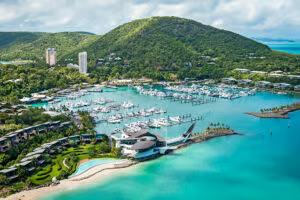
As for destinations incentive decision makers are considering, Gilligan says “Oceania is having its moment” with a “very significant” increase in those who are including the region in the mix as a possible choice.
South and Central America are also rising as is the Caribbean, although to a lesser extent, while Western Europe has seen a slight drop in popularity, and Mexico has seen a more severe drop, as have – unsurprisingly – the Gulf states.
There are a few other essential points to note from the research – some of which should sound a warning for the incentive sector.
Currently, most incentive travel qualifiers would rather take cash over an incentive travel reward. As Sinclair said, “that should make everyone sitting in this room continue to feel quite uncomfortable”.
Alongside this, 53 per cent of survey respondents said the younger generation of qualifiers would not attend an incentive trip if the destination or program didn’t match their values.
And then there’s artificial intelligence. After another year of rising adoption, now just 15.2 per cent of those surveyed say they’re not using it. Increasingly, it is being used for content creation, supplier sourcing and RFPs, budgeting and optimising cost, program design, scenario modelling and risk management.
However, as both Gilligan and Sinclair pointed out, AI uptake is not actually relieving any pressure.
“Interestingly, the tools are here but as an industry we have not found yet really the ability for it to help us to create hyper personalisation in the programs that we’re organising,” said Sinclair.
Just 21 per cent of those surveyed said AI was helping them deliver better programs.
“AI has come in potentially as an operating instrument or assistant, but it hasn’t actually made the operating environment any easier because so many other variables and factors are impacting on it,” said Gilligan.
He flags another issue.
“There’s an operational squeeze happening out there, which frequently gives less line items and budgets to spend in destinations because so much is [being spent] on things outside the destination or on one thing in the destination, like hotels.
“In previous Incentive Travel Indexes, we’ve identified about 70 per cent of the spend already being committed to airline and hotel, which would only leave 30 per cent for the actual destination experience.
“What we’re seeing [in 2026] is that airline costs have become a significantly bigger short-term challenge than ever before.”
Although air travel shows the starkest uplift as an operational challenge – cited by nine per cent as such in 2025 and 28 per cent in 2026, a variety of other operational issues are also biting – as Gilligan put it in the slide deck “every major operational category deteriorated” – from political issues to international instability, accommodation availability, budgets and the volatility of exchange rates.
The full results of the Incentive Travel Index research for 2026 will debut in October. Australia and New Zealand got a sneak peek due to SITE ANZ galvanising the highest volume of responses for the research by a single chapter worldwide.